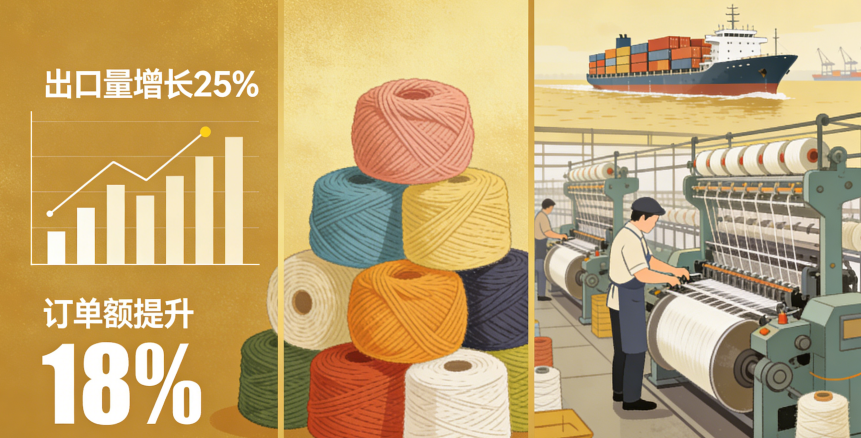
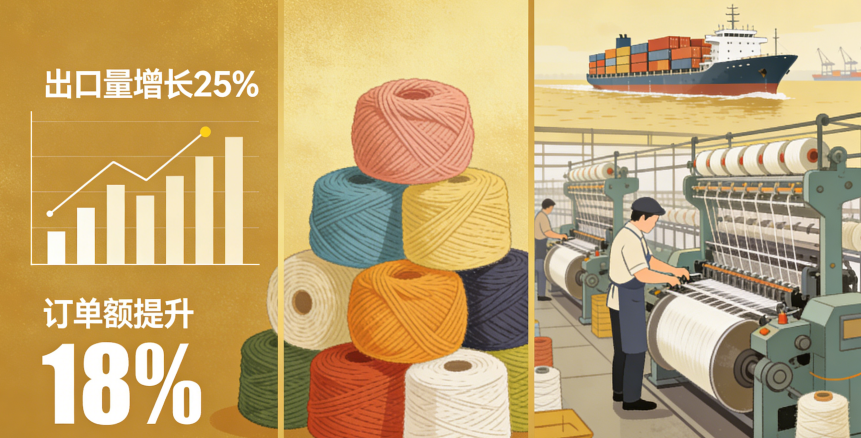
The spring breeze brings warmth and foreign trade recovers. At the beginning of 2026, China’s wool textile industry delivered a “report card” that far exceeded expectations. According to the latest data from the General Administration of Customs of China, from January to February this year, my country's total import and export of wool raw materials and products reached 2.33 billion US dollars (equivalent to approximately RMB 16.4 billion), a year-on-year increase of 16.9%; of which the export volume reached 17.7 billion USD, with a year-on-year growth rate of 18.9%. After experiencing deep adjustments in the past few years, this strong data undoubtedly declares that China's wool textile industry is strongly coming out of the trough and ushering in a deterministic restorative growth cycle.
1. Upstream "leading", semi-finished product exports exploded
This round of export recovery shows distinct structural characteristics - the upstream semi-finished products industry leads the way and has become the core engine for growth. Breakdown data shows that the growth rate of raw material processed products at the front end of the industrial chain is far ahead:
- Wool strips: Exports were 8,375 tons, a year-on-year surge of43.8%, and export value was US$70.51 million, an increase of28.5%.
- Wool yarn: Exports were 7,230 tons, a year-on-year increase of38.0%, and export value was US$170 million, an increase of27.6%.
- Plush-free cashmere: As the core raw material of the cashmere industry, its growth rate is the highest in the entire industry, directly confirming the overall recovery of demand in the global high-end cashmere market.
This set of data profoundly reveals two major industry trends: First, China's position as the "hub" of the global wool textile industry chain is irreplaceable. Global apparel brands and manufacturers are accelerating their centralized procurement of high value-added woolen semi-finished products from China, relying on China's mature carding and spinning technology and stable production capacity. Secondly, Behind the “rising volume and price” is the restructuring of the global supply chain and the need for replenishment. After going through the destocking cycle from 2024 to 2025, the inventories of overseas brands and garment factories are at low levels, and the autumn and winter orders in the northern hemisphere have started in advance, which has concentrated on releasing strong purchasing demand for upstream raw materials.
2. Downstream differentiation: The volume of ready-made garments has increased and prices have fallen, and high-end breakthroughs have become the key
Compared with the rapid progress of the upstream, the performance of the downstream finished products shows obvious differentiation, with mixed results.
- Wool sweaters/cashmere sweaters: As a necessity for the public in winter, the export volume reached 5.61 million pieces, a year-on-year increase of29.5%, and the export value increased25.8%. Although demand is picking up, the industry is generally stuck in the dilemma of "increasing volume and falling prices"**. Low-price competition is launched to compete for orders, and corporate profits are severely squeezed.
- Wool woven clothing: performed the weakest, with export volume falling sharply 33.0% year-on-year. Although the export value only dropped slightly by 1.2%, reflecting an increase in product unit price, the shrinking total volume reflected the decline in the competitiveness of traditional formal wear and outerwear woolen products in the international market.
This differentiation clearly points out the future path of the industry: The old road of low-end production capacity and low-price competition has come to an end. Only by transforming to high-end, functional and branding can we escape from involution and obtain real growth dividends. Data shows that high-end products such as high-count wool yarn and functional blended fabrics exported during the same period not only had full orders, but also had strong prices, becoming the main contributor to industry profits.
Three and three combined forces drive the industry to a "good start"
The strong rebound in woolen exports is not caused by a single factor, but the result of the resonance of the three factors of recovery of global demand, upgrading of domestic industries, and release of policy dividends.
First, global market demand has picked up and the inventory replenishment cycle has started.Inflation in major economies such as Europe and the United States has dropped, interest rates have declined, consumer confidence has gradually recovered, and demand for winter clothing has rebounded. At the same time, after nearly two years of inventory reduction, overseas clothing brands are currently in the low replenishment stage, with a large number of orders returning to China. In addition, RCEP
As the free trade agreement continues to deepen, China's woolen products exports to ASEAN, New Zealand and other markets will enjoy preferential tariffs, and market expansion will become smoother.
Second, the supply of raw materials is tightening and rising prices support the market. Production in major wool-producing areas around the world has been reduced, and the supply pattern has undergone fundamental changes. 2026
At the beginning of the year, China's imports from Australia, New Zealand, and South Africa, the three traditional wool-producing countries, declined significantly year-on-year (Australia - 15.55%, South Africa -
21%). The scarcity of high-quality wool raw materials has directly pushed up the price of wool, driving up the value of upstream processed products. It has also prompted overseas customers to accelerate their locking of Chinese supply sources, further pushing up export data.
Third, industrial upgrading and intelligent manufacturing will build a solid foundation for competitiveness. Faced with the complex foreign trade environment, Chinese wool textile companies have accelerated their efforts to break through technological innovation. AI
Design, 3D virtual proofing, smart spinning and other technologies are widely used, which greatly shortens the delivery cycle and improves the "quick response for small orders"
flexible supply capabilities. Taking industrial clusters such as Zhejiang Honghe and Jiangsu Jiangyin as examples, through the combination of intelligent transformation and cross-border e-commerce, exports to emerging markets such as South America and Central Asia have grown as high as 30%.
above. At the same time, the state's special subsidies and low-interest financing support for green textiles and intelligent manufacturing have also effectively reduced the transformation costs of enterprises and enhanced export competitiveness.
4. Opportunities and challenges coexist, and high-quality development is the only way
The 18.9% growth rate is certainly exciting, but the industry must clearly realize that short-term data rebound does not mean long-term peace of mind, and the road to recovery still coexists with opportunities and challenges.
Challenges: Global wool raw material prices are running at high levels, which will continue to squeeze downstream profit margins; international trade protectionism is on the rise, green barriers and technical barriers are increasing; low-end products are homogenized and competition is fierce, and the haze of "price wars" is hard to dissipate.
Opportunities: Under the global trend of sustainable fashion, natural and renewable wool fibers are favored and have broad market prospects; China's wool textile industry is rapidly forming advantages in high-end and functional (temperature control, antibacterial, easy care) tracks; emerging markets along the "Belt and Road" and in South America and the Middle East have huge potential, opening up incremental space for the industry.
Standing at a new starting point, the future direction of China's woolen textile industry is already clear: It is necessary to completely abandon the old model of scale expansion and low-price competition, and firmly follow the high-quality development path of "strengthening the chain in the upstream, improving quality in the midstream, and creating brands in the downstream"**. Control high value-added links through technological innovation, build core barriers through green sustainability, and disperse risks through diversified market layout.
The strong recovery at the beginning of the new year is a clarion call and a starting point. The 18.9% growth rate is not only a beautiful set of data, but also a strong proof of the resilience and competitiveness of China's wool textile industry chain. In the tide of restructuring of the global textile supply chain, only by continuing to evolve and move higher can China's wool textile industry firmly grasp the dividends of recovery and steadily move from the "world's factory" to the "global wool textile industry highland".