
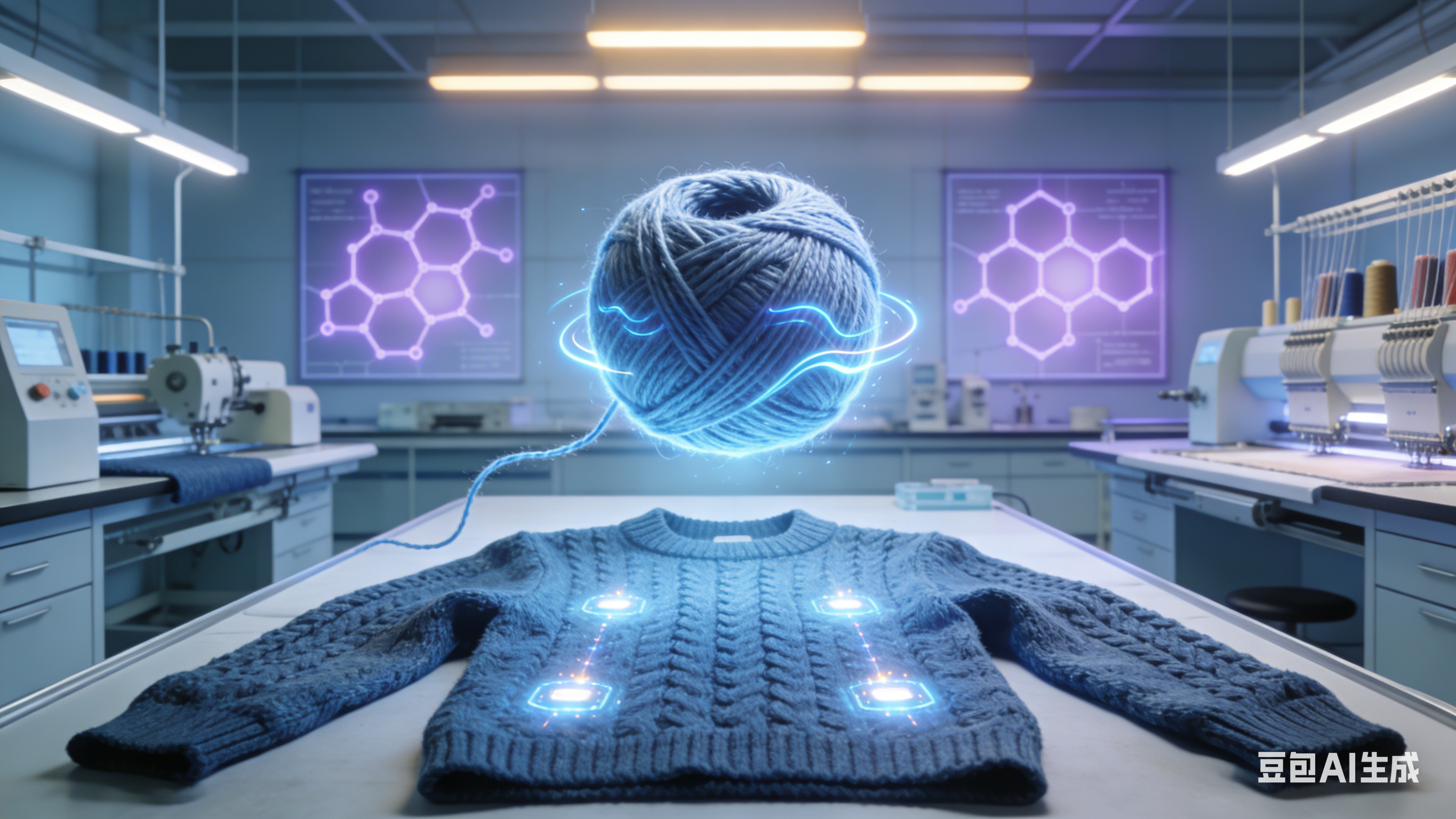
When traditional wool is injected into technological genes, a profound industrial change is quietly taking place. Wool, once only used as a basic textile raw material, has now broken through the basic properties of warmth and softness. Through material innovation, process breakthroughs and technological integration, it has evolved into a "technological engine" that determines clothing performance and defines the wearing experience. From intelligent temperature control to health protection, from conductive interaction to eco-friendliness, functional wool is completely rewriting the value logic of the wool spinning industry and promoting the leap from traditional textiles to high-tech industries.
1. Breaking out of the cocoon and becoming a butterfly: wool jumps out of the raw material properties, and the performance revolution breaks out
The value of traditional wool is limited to the natural properties of the fiber itself - wool is warm, cashmere is soft, and cotton is breathable. Functionalized wool uses molecular design, nanocomposite, bionic structure and other technologies to give wool "superpowers" beyond its natural properties, making a yarn the core carrier of clothing performance.
1. Temperature control revolution: intelligent temperature regulation, constant temperature in all seasons
Phase change temperature-controlled wool has become a dual solution for warmth in winter and coolness in summer. By implanting microcapsule phase change materials inside the fiber, the wool can automatically absorb or release heat according to the ambient temperature: when the temperature drops, the material in the capsule solidifies and releases heat; when the temperature rises, it melts and absorbs heat, achieving bidirectional temperature regulation. The intelligent temperature-controlled protein fiber developed by Beijing Snow Lotus has a phase change enthalpy far exceeding that of similar international products. The underwear made from it can maintain a constant body feel between - 20°C and 20°C.
Bionic thermal wool achieves a breakthrough in "lightweight, thin and efficient". The EAF fiber, developed by Zhejiang University to imitate the hollow structure of polar bear fur, can achieve the same warmth retention effect with only 1/5 the thickness of traditional down. It has 1600% ductility and will not degrade in performance after being washed hundreds of times. This kind of "aerogel wool" allows extreme cold clothing to bid farewell to heavy and bloated clothing and become a new favorite in the outdoor and aerospace fields.
2. Health protection: antibacterial and anti-mite, long-lasting protection
Graphene composite wool uses nano-scale physical antibacterial mechanisms to build a health protection barrier. Graphene microchips can pierce bacterial cell membranes, inhibit Staphylococcus aureus and Escherichia coli by over 99%, and are resistant to washing for more than 50 times without deterioration. Compared with traditional chemical antibacterial agents, physical antibacterial agents are safer and non-toxic, making them the preferred material for infant clothing and medical textiles.
Far-infrared functional wool has both the functions of warmth and health care. By mixing ceramic particles into the fiber, it can continuously absorb body heat and reflect 4-14 micron far-infrared rays, promoting skin microcirculation and improving immunity. It has become a core material for warm clothing and sports rehabilitation equipment for middle-aged and elderly people.
3. Intelligent interaction: conductive sensing, wearable "alive"
Super elastic conductive wool breaks through the rigid limitations of traditional electronic fabrics. The "adhesion-channel synergy" conductive yarn developed by Donghua University perfectly combines liquid metal and elastic fiber. It can be stretched600%with a resistance change of only 0.7%. It still maintains stable conductive properties after repeated bending and washing. This kind of wool can be woven directly into clothing, replacing traditional circuits and wires, and made into ECG monitoring clothing, sports sign clothing, heated vests and other smart wearable products.
Shape memory wool also allows clothing to have the ability to "actively deform". The programmable textile metasurface developed by Jiangnan University, through the geometric structure design of special wool, can realize complex morphological changes such as plane-to-stereo conversion, concave-convex deformation, and camouflage as the temperature and humidity change, showing great potential in the fields of smart clothing and flexible robots.
4. Practical upgrade: anti-wrinkle and easy care, durable and anti-aging
High shrinkage functional wool completely solves the pain points of wool that is easy to wrinkle and difficult to care for. After blending with wool, heat treatment can make the fabric shrink and tighten, increase elasticity by 40%, greatly enhance wrinkle resistance, and achieve machine washability without deformation and shrinkage of less than 3%. And multi-functional composite wool such as anti-static, anti-UV, water-repellent and oil-repellent, uses nano-coating and fiber copolymerization technology to give a piece of clothing multiple protective capabilities at the same time, making it suitable for diverse scenes such as outdoor, workplace, and sports.
2. Technical core: three major innovation paths, forging the "superpower" of wool
The performance leap of functionalized wool stems from the deep integration of material science, textile engineering, and nanotechnology, forming three core technology paths:
1. Fiber modification: reshaping performance from the molecular level
- Copolymerization and grafting: Functional monomers are introduced during the fiber polymerization stage, so that antibacterial, conductive, temperature control and other groups become part of the fiber molecular chain, and the properties will never fall off.
- Nanocomposite: Nanomaterials such as graphene, carbon nanotubes, and ceramic particles are evenly dispersed in the spinning solution, giving the fiber characteristics such as high strength, high thermal conductivity, and antibacterial shielding.
- Bionic structure: Imitating natural structures such as the hollowness of polar bear hair, hydrophobic lotus leaves, and smooth silk, special cross-section fibers such as porous, hollow, and grooved are manufactured through special-shaped spinnerets to achieve efficient warmth retention, quick drying, and moisture conduction.
2. Blended interweaving: multi-functional synergy
Achieve "1+1>2" performance superposition through wool + functional fiber blending:
- Wool + graphene: Quadruple functions of warmth + antibacterial + conductivity + antistatic
- Wool + phase change fiber: dual advantages of natural warmth + intelligent temperature regulation
- Wool + high shrinkage fiber: a perfect combination of softness, plumpness + anti-wrinkle and easy care
3. Post-finishing empowerment: green process enhancement function
Green processes such as low-temperature plasma, ultrasonic waves, and supercritical CO2 are used to implant functional agents into the fiber without damaging the fiber:
- Antibacterial finishing: deep adsorption of natural antibacterial agents such as silver ions and chitosan, long-term antibacterial
- Water and oil-repellent: fluorocarbon nano-coating, forming a lotus leaf effect, waterproof, anti-fouling and breathable
- Anti-static: conductive particles are embedded in the surface of the fiber to eliminate static electricity problems
3. Industrial Reconstruction: Functionalization Leads the Value Jump of Wool Textile
The transformation of the role of wool from "raw material" to "engine" is completely restructuring the competitive landscape and value system of the wool spinning industry:
1. Shifting the focus of value: from "selling weight" to "selling technology"
Traditional woolen yarns are priced in "tons", with slim profits; Functional woolen yarns are priced in "performance" and the added value is increased 3-10 times. The profit of a high-end intelligent temperature-controlled wool yarn is equivalent to 10 tons of ordinary wool yarn. The industry is accelerating away from "low-price involution" and moving towards a high-quality development track of technology premium and brand premium.
2. Application boundary expansion: from clothing to full scene coverage
Functional wool breaks the limitation of "for clothing only" and penetrates into diverse fields such as medical health, outdoor sports, aerospace, smart home, smart wear:
- Medical: antibacterial surgical clothing, far infrared rehabilitation protective gear, pressure therapy socks
- Outdoor: extreme cold thermal clothing, sun protection quick-drying clothing, waterproof jackets
- Military industry: conductive communication clothing, temperature control camouflage clothing, radiation protection equipment
- Home: smart temperature control blanket, antibacterial bedding, anti-static curtains
3. Upgrading of competition barriers: technological innovation becomes core competitiveness
Enterprises with independent technology for functional wool have quickly established irreplaceable barriers to competition. Leading companies such as Shandong Ruyi and Jiangsu Sunshine have become the exclusive suppliers of international brands with core technologies such as intelligent temperature control and graphene composite. However, small and medium-sized enterprises that lack technical reserves are being eliminated by the market at an accelerated pace, and industry concentration continues to increase.
4. The future picture: wool technology, the emergence of "new species" in textiles
With the deep integration of material science and intelligent manufacturing, functional wool is moving towards a new stage of intelligent, ecological and multi-functional integration:
- Full-sensory smart yarn: Integrate multiple sensors for temperature, humidity, pressure, and heart rate to make clothing a "Health monitoring terminal"
- Self-cleaning ecological wool: Photocatalytic nanomaterials give fabrics the ability to automatically degrade stains and purify the air
- Degradable bio-yarn: Bio-based materials such as polylactic acid and seaweed fiber realize production-use-recycling full life cycle environmental protection
- Digital twin yarn: AI design + 3D Virtual weaving enables accurate performance customization and rapid iterative development
Conclusion: A yarn revolution, the rebirth of an industry
The functional revolution of wool is not only an upgrade in material performance, but also a rebirth of the value of the traditional textile industry. When an ordinary yarn is injected with technological genes, it transforms from a passive thermal insulation material into a "technological engine" that drives clothing performance, defines wearing experience, and expands application boundaries.
For the wool textile industry, this is both a challenge and an opportunity - only by abandoning the old model of scale expansion and low-price competition and firmly following the new path of technological innovation, functional upgrade, and value improvement can we seize the opportunity in this industrial evolution.In the future, the competition in the wool spinning industry will no longer be "whose wool is cheaper", but "whose wool is more technological, more functional, and more understanding of life."
From a strand of wool to a technological yarn, from traditional textiles to high-tech industries, functional wool is using its tiny body to leverage the gorgeous turn of the entire industry and write a new chapter in the high-quality development of Chinese wool textiles.