
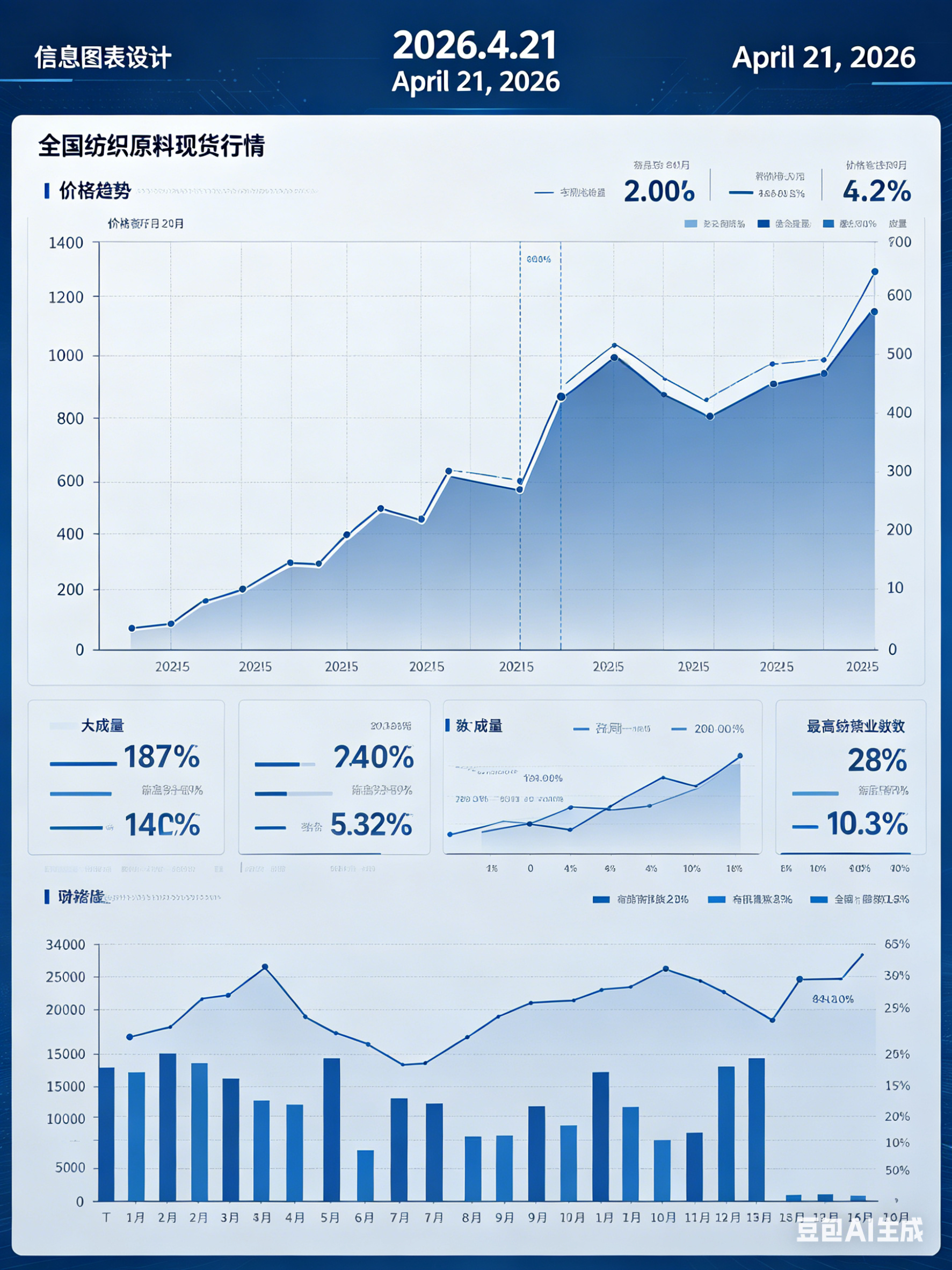
On April 21, 2026, the domestic textile raw material market showed a pattern of "natural fiber shortage and chemical fiber trend differentiation". Combined with the international commodity market, the prices of various raw materials and market supply and demand showed obvious differences, which had a direct impact on the production and operation of downstream weaving and wool spinning enterprises.
Wool In terms of the wool market, the shortage situation continues to intensify. Affected by the reduced production of Australian pastures and insufficient slaughter volume, the price of international fine Australian wool increased by more than 40% year-on-year. The spot supply is tight and the price remains high and strong for a long time. Domestic fine wool and combed wool have simultaneously maintained high prices. The spot circulation volume is relatively small, and the shortage of upstream raw materials has formed a strong support for the cost of the wool spinning industry. Industry analysts believe that the global wool supply gap will be difficult to alleviate in the short term, and there is still room for upward price growth. Downstream companies need to plan raw material procurement in advance and optimize blending ratios to balance cost pressures.
In the chemical fiber sector, affected by the shock of international crude oil prices, the trend showed differentiation. Brent crude oil continues to fluctuate within the $98 range, providing basic support for chemical fiber raw material prices. Specifically, the prices of polyester products fell back. The prices of polyester staple fiber, POY, and DTY fell by 3.75% to 7.6% compared with last week, but the monthly increase was still more than 29%, mainly affected by upstream cost transmission and downstream demand off-season; viscose staple fiber continued to strengthen, and market demand was stable; acrylonitrile remained low and stable, and the overall chemical fiber raw material cost pressure has eased compared with the previous period.
The cotton market also performed strongly, with domestic and foreign cotton prices rising simultaneously, and lint prices increasing by more than 21% year-on-year. Affected by production cuts in Xinjiang and drought in major overseas producing areas, cotton supply continues to be tight. On the downstream weaving end, the weaving operating rate in Jiangsu and Zhejiang remained at 52.72%. The traditional off-season in April continued. Market orders were mainly small orders and foreign trade return orders. Most companies focused on digesting inventory and purchasing on demand, and the overall production rhythm was stable.